

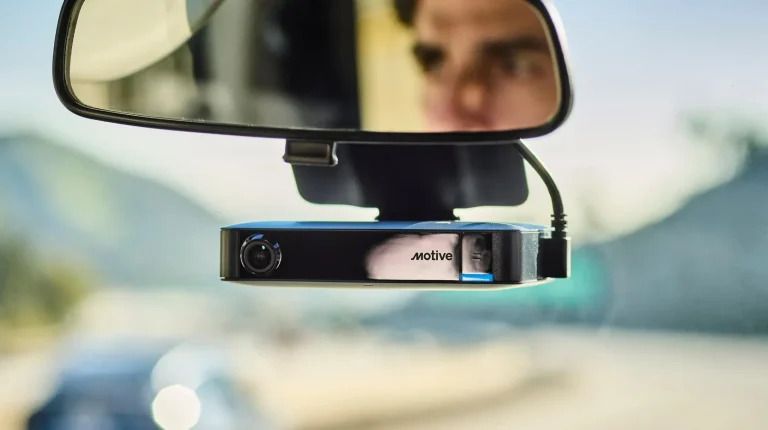
Motive has launched the AI Dashcam Plus, a dashcam that combines enhanced AI capabilities, hands-free communication and integrated hardware in a single device. Using edge AI to detect driving risk more quickly, the system has been designed to help reduce collisions.
Powered by the Qualcomm Dragonwing QCS6490 processor, it provides increased AI processing capacity and supports the simultaneous operation of more than 30 AI models, enabling broader detection with fewer false alerts. The device features dual forward-facing stereo vision to improve visibility and integrates live, hands-free two-way calling, with a unified design intended to improve reliability and reduce installation time.
“Collision rates and related costs remain unacceptably high around the world,” said Shoaib Makani, co-founder and CEO of Motive. “Organizations need AI-powered driver safety solutions that can perceive and respond in real time. We’ve added three times more compute, created the first AI dashcam with stereo vision, and added hands-free communication, all in one system, so organizations can detect more risks and act faster. This isn’t just a new product; it reflects a shift toward proactive, AI-driven road safety.”
Improved AI power
AI Dashcam Plus is powered by the Qualcomm Dragonwing QCS6490 processor, which provides three times more AI compute than previous versions. It can run more than 30 high-precision AI models simultaneously, supporting broader detection capabilities and enabling more accurate, lower-latency real-time identification of unsafe behaviors.
AI Dashcam Plus uses dual synchronized road-facing lenses to provide stereo vision, improving depth perception and enabling more accurate estimation of distance and closing speed. This supports enhanced forward collision warning, lane swerving and close-following alerts. The system also includes a 1,440px narrow field-of-view zoom lens that supports automatic license plate recognition, capturing clear plates in motion and in poor weather conditions to support incident investigation and driver exoneration.
The dash camera integrates video, audio, telematics, GPS and dual motion sensor data to detect more complex events, such as a break-in from the sound of glass shattering or to confirm a low-severity collision from subtle vibration patterns, events that other competing dashcams miss entirely.
“Motive’s AI Dashcam Plus shows how on‑device AI can transform road safety at scale,” added Erick Hong, head of Smart Home & Life, Qualcomm Technologies. “Built on the Qualcomm Dragonwing QCS6490, it delivers the concurrency, responsiveness and reliability fleets need – running numerous AI models at the edge with lower latency. We’re proud to collaborate with Motive to help organizations detect risks sooner, communicate instantly and keep drivers and communities safer.”
Redefining communication
AI Dashcam Plus supports hands-free communication, allowing drivers to connect with managers using voice commands, while managers can contact drivers through the Motive dashboard or Fleet app. Drivers can safely report issues, request assistance or respond to check-ins without distraction. An AI voice assistant enables voice-activated functions such as saving video footage, checking journey time and locating nearby services. Automated alerts help address time-sensitive issues, including fault codes and excessive idling. The unified design combines the AI dashcam and vehicle gateway into a single device, reducing installation time and simplifying hardware management. An Android-based platform supports secure connectivity, over-the-air updates and optimized AI processing, while dual-SIM, multi-carrier 4G connectivity helps maintain vehicle tracking and reliable video uploads, including in areas with limited coverage.
“Improving driver and vehicle safety is among the top three priorities for truckload carriers globally when adopting new technologies, according to the 451 Research Supply Chain Digital Transformation survey 2025,” said Beatriz Minamy, principal analyst at S&P Global Market Intelligence. “AI-powered solutions that enable real-time coaching, automated in-cab alerts for unsafe behaviors and proactive risk detection are becoming central to how fleets strengthen safety and accountability.”
In related news, Virtual cockpit environment from Elektrobit enables rapid building of HMIs and SDV applications