

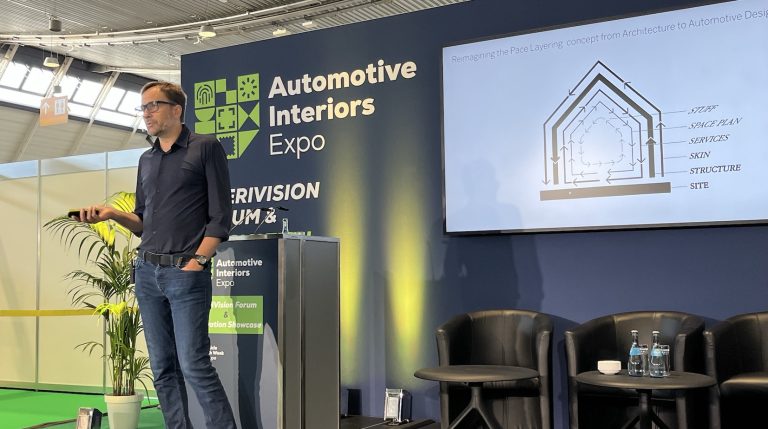
Artur Mausbach, a senior research fellow at the Royal College of Art, has been on stage at the Automotive Interiors Expo InteriVision Forum at Messe Stuttgart, Germany, to discuss PaceDriven – an approach that enhances disassembly, versatility and upgradeability as key strategies for extending product lifecycles and reducing environmental impact.
The PaceDriven design approach sets out to improve circularity and achieve carbon neutrality by rethinking how to extend the lifetime of vehicles and minimize their environmental impact, generating a new way of doing automotive design and business.
The vehicle is broken down into five layers: structure, skin, surface, scenery and stuff. This separation enables design teams to consider the specific materials and processes for each layer, with circularity as the main focus throughout.
PaceDriven is the result of the Creative Sustainability research-through-design (RtD) project at the RCA Hyundai Kia Innovation Laboratory, which rethinks the car for the 21st century. Working with Kia, Mausbach presented the versatile concept, developed in conjunction with Kia, based on making the vehicle modular, adapting the interior to suit a standard four-seater, a pickup, a two-seater commuter vehicle and a commercial vehicle (in the concept, a coffee car).
The approach acknowledges the reality that designs go out of date and will be recycled after three to five years. However, it raises the question of consumerism – promoting the idea that nothing is permanent. As an industry, we cannot forget that the process of recycling also takes time and energy. To this, Mausbach said, “There must be a balance. We try to associate the lifespan with the ecological footprint of each material at each stage. This is how we manage that. The great benefit is that the enormous footprint of building a car is no longer simply thrown away.
“By separating the elements, by forcing design to treat materials more distinctly, it becomes a real challenge. The challenge is to make components easily separable, so they can be genuinely recycled rather than becoming the compacted waste that ends up in landfills today. That is the difference we are trying to make.”
But the reality is that concepts like this exist free from the constraints of cost. The harder question is, how do we turn provocation into practice?
The InteriVision Forum runs until 4.30pm today, Wednesday, June 24. Automotive Interiors Expo continues tomorrow