

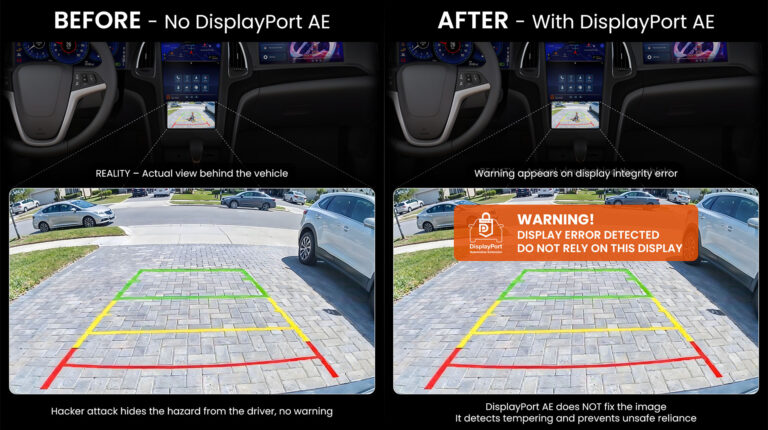
The Video Electronics Standards Association (VESA) has released version 1.1 of its DisplayPort Automotive Extension (DP AE) specification – the first open industry standard for functional safety and security in automotive display systems. DP AE v1.1 incorporates a fully executable, normative software emulator that enables silicon manufacturers, system integrators and automotive OEMs to design and validate DisplayPort- and Embedded DisplayPort (eDP)-based devices to meet international standards for automotive safety (ISO 26262 ASIL-D) and security (UN R155, ISO 21434).
The centerpiece of the DP AE v1.1 update is a ‘white-box’ C-model software emulator that implements all four normative safety and security profiles defined in the DP AE specification. These profiles add layered protection for main video data paths, auxiliary channels and overall system integrity, enabling stakeholders to verify frame-level fidelity, detect tampering and enforce cryptographic authentication in automotive display pipelines.
DP AE v1.1 includes four cumulative profiles.
Profile 1: Mandatory functional safety via cyclical redundancy check and frame counters generated on each video frame on the data path. This ensures that a frame is never corrupted, dropped or repeated, and that critical events are always captured and never missed. Additional video frame time-out monitoring ensures that both the source and sink maintain the data path link integrity.
Profile 2: Scales up the functional safety coverage described above, along with messaging, routing and notifications to support more complex deployments and vendor-defined measurements.
Profile 3: Continues to extend Profile 2 but adds advanced security to the auxiliary messages through secure channels established by device authentication. In addition, the device certificate securely protects against counterfeits and unsafe aftermarket modifications.
Profile 4: In addition to protecting the auxiliary messages in Profile 3, Profile 4 extends the security coverage to the data plane by adding integrity and anti-replay protection on the video frames.
These profiles support real-world implementations using the latest versions of DisplayPort (version 2.1a) and eDP (version 1.5a) without sacrificing bandwidth or requiring PHY changes. The DP AE standard supports compressed and uncompressed video as well as multistream transport (MST) for up to 16 display regions of interest.
DisplayPort ideal for automotive displays
Most high-resolution automotive displays use DisplayPort or eDP to carry video data from the central vehicle computer, or ECU, to the displays. In addition to its high video bandwidth capability, DisplayPort’s MST enables multiple displays to be connected to a single DP source port. However, until the introduction of VESA’s DP AE standard, there was no standardized way to verify that the data transmitted from the ECU was received by the display in the same way that it was sent, ensuring it was free of noise injection errors and had not been the target of malicious tampering.
“With DP AE v1.1, VESA now offers a fully executable specification that can be directly integrated into automotive display design and test workflows. This release provides silicon providers, certification labs and automotive OEMs with a complete, open-standards-based approach to delivering secure, safety-critical displays,” said James Goel, DisplayPort automotive extension lead and VESA board member.
The C-model emulator is developed for design engineers creating source (ECU), bridge (serializer/deserializer) and sink (receiver, timing controller) devices, test labs and compliance test specification (CTS) technicians preparing for formal compliance testing, and OEM validation teams verifying display system safety and authenticity.
The emulator is available as a Linux application and can be integrated into software testing environments. A Windows-based graphical interface is under development to support automotive technicians in manufacturing and validation roles.
VESA is concurrently developing a CTS and logo program for DP AE, which will enable formal product validation and certification. The CTS is currently under review and is expected to be finalized later in 2026. Early feedback from VESA-certified authorized test centers and industry contributors is helping to guide development of the program.
Dozens of VESA member companies have contributed to the development and validation of DP AE.
Brian Turner, president of BTA Design Services, a VESA member, said, “BTA Design Services is excited to be at the forefront of automotive display technology innovation, collaborating with VESA and its member companies from the very start of the DisplayPort Automotive Extension standard. As a key contributor, we take pride in architecting and developing the DP AE compliance test specification reference C-Model software emulator and delivering leading-edge, standards-compliant IP designed for 2026 Q4 silicon deployment. We look forward to showcasing an early release of our DP AE IP in 2026 Q2.”
Added Joe Mendolia, vice president of marketing for Teledyne LeCroy’s Protocol Solutions Group, “Teledyne LeCroy has consistently led adoption in new VESA technology initiatives, and we’ve now launched our first solution for Automotive Extensions on our flagship quantumdata M42de analyzer/generator platform. Our efforts to provide early support for the DP AE specification will enable automotive innovators to confidently test prototype devices for safety and interoperability.”
In related news, Teledyne LeCroy adds VESA DisplayPort AE support to video analyzer