

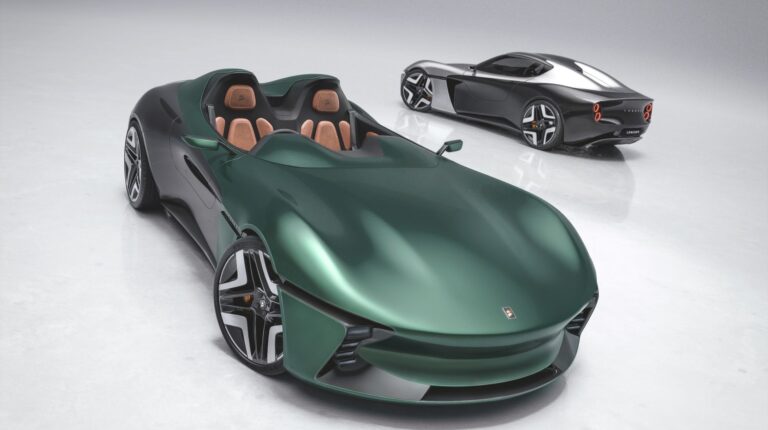
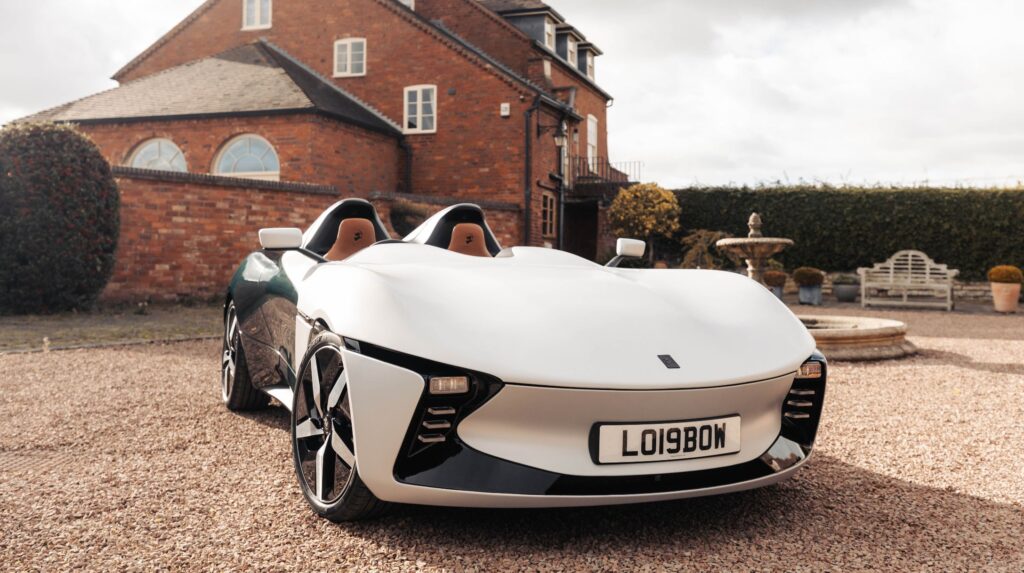
Longbow has unveiled the Aesthetic Dynamic Demonstrator of its first Featherweight Electric Vehicle, the Speedster, the product of a program that was completed from initial sketch to road-ready form in just six months – around a year faster than traditional OEM development cycles. Automotive Interiors World speaks with CEO Daniel Davey and COO Mark Tapscott about the development, inspiration and expectations behind this new British sports car brand.
While the Speedster prototype, one of two lightweight models in development, showcases the brand’s exterior design language and lightweight engineering, the interior has not yet been fully revealed. Longbow states that the production cabin will follow the same minimalist, driver-focused philosophy alongside hand-finished materials.
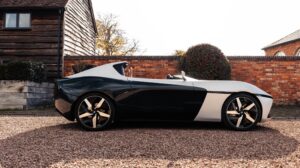
The open-top Speedster delivers 0-62mph in 3.5 seconds, weighs 895kg and offers a 275-mile WLTP range, while the closed-top Roadster reaches 62mph in 3.6 seconds, weighs 995kg and provides a 280-mile WLTP range.
What is one principle you are uncompromising on in Longbow’s design and development?
Daniel Davey (DD): Our core principle is lightness. This principle applies not only to the mass perspective but also from a driving perspective.
Mark Tapscott (MT): We don’t focus on stats; we want you to forget about everything else. We want you to be fully focused on the driving experience, engaged in the theatrical way in which the car inspires you. And then, when you’ve finished driving and you’re walking away and you lock the car, we want you to turn back around to have another look at it again – because it’s so beautiful.
How do you define beautiful?
MT: Beauty is finding that balance between form and function. It doesn’t have trends. Beauty is immutable.
How do you see the dual heritage (classic and innovative) shaping the design and message of your vehicles? And how do you make a vehicle authentically Longbow?
MT: We have attempted to create a modern sports car that is neither too futuristic nor too much of a pastiche. The rear end is inspired by futuristic possibilities – a technical form that is very aerodynamically focused – while the front end is beautiful, mimicking skin that’s stretched out across the car. It draws on what we believe are some of the most beautiful vehicles ever made – the sports cars of the 1960s.
DD: We are relentlessly focused on changing how the world feels about sports cars. We believe they’ll still be on the road a hundred years from now – enduring and transcendent, like the very first cars ever made.
Why electric?
DD: We think the best powertrain available in 2025 is electric.
Longbow emphasizes the philosophy of “adding lightness”. What does lightness mean to you beyond just reducing weight?
DD: We leveraged this from the father of lightness, Colin Chapman, English designer, engineer, inventor and founder of the sports car company Lotus Cars. When we say adding lightness, most of the time, that means not adding complexity.
MT: The best component is no component.
How has this influenced the interior?
MT: You will have to wait and see.
How do you enforce lightness?
MT: Many engineers haven’t worked with lightness at the forefront of their thinking. By applying a simple rule — that every designer or engineer must remove just one gram from their work every day until the design freeze — you can inspire genuinely novel approaches to lightweighting. It all comes together like an orchestra, where everyone contributes a small part that unites to form the whole piece.
Which of the two vehicles calls to you firsty, and why?
MT: I choose the Roadster. Our experiences with small, lightweight cars are so far away from what they can and should be. We are trying to engineer that and wrap that in a design that is beautiful and usable. Trying to be a sports car with those characteristics is probably the hardest challenge that hasn’t yet been answered. That’s why we’re taking it on.
DD: The Speedster for me sets the direction and statement of intent for us as a company. Speedsters are typically priced in the millions, sold before they’re announced, and they never see the light of day. We could align with the market, but we’re not here to do that. We’re here to build very beautiful, very cool cars that people drive every day. They shouldn’t be kept in a glass case and looked at from afar because there’s only one of them.
Longbow is unapologetically an EV sports car …
DD: We are not looking to be vertically integrated. The market has come a long way and if you work with the right suppliers, you can buy components that are as good – or sometimes even better – than what larger companies produce in-house. We have utilized Lucid technology as well as our own technology, prioritizing lightweight, resilience and durability.
Are there innovations in EV performance or lightweight materials that you’re excited to explore in future vehicles?
DD: We’re exploring modular chassis technology, which reduces bonding, adhesive use, weight and complexity. We also want to explore additive manufacturing. 3D printing has advanced in leaps and bounds in both quality and output versatility, offering opportunities for levels of customization that others haven’t achieved before.
How does Longbow approach testing before a vehicle’s debut?
DD: Humans are humans. We may conduct some testing in Spain over the winter, and we will follow the protocols for both extreme high and low temperatures. We’ll also test the vehicles according to real-world driving use cases to ensure we deliver on our promises. Each vehicle’s testing process will be customized based on how it will likely be used. For example, the Speedster will probably serve as a commuter for fewer people, while the Roadster will see broader use.
Of course, there are interesting things we can do now before we even get to physical testing. For example, you can run hundreds of thousands of miles of simulated tests, but I don’t think it’s a substitute for real-world testing. But the best thing to give you feedback on a car on the road is a human, because it’s going to be a human operating it, not a digital twin of a human.
As for where we stand right now, we’re moving to ramp up the miles on a vehicle that is moving closer to what we will have as a production vehicle. Testing tends to start ramping up nine months before delivery. Delivery is scheduled for the end of next year.
What are your thoughts on testing in the UK?
DD: The UK is a fantastic place to test cars with facilities such as Horiba Mira and Millbrook. There isn’t a better place in the world to build an electric sports car than the UK.
What are your first thoughts when I say Longbow?
DD: Longbow was named to represent the intersection of man and machine. Longbow is nothing without a driver, and without an archer, it is nothing but a longbow.