

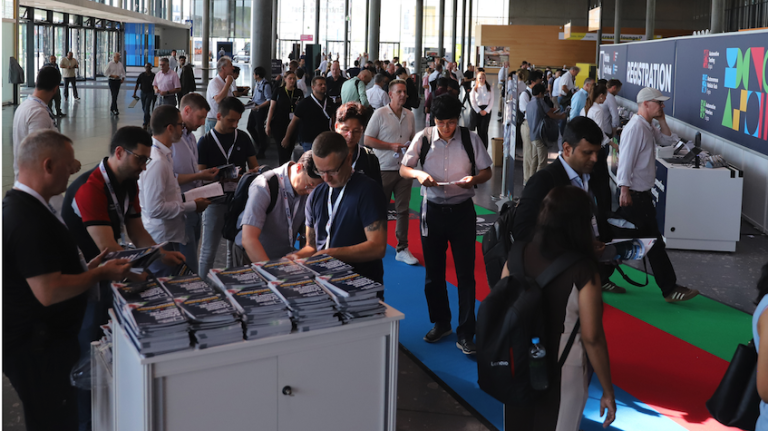
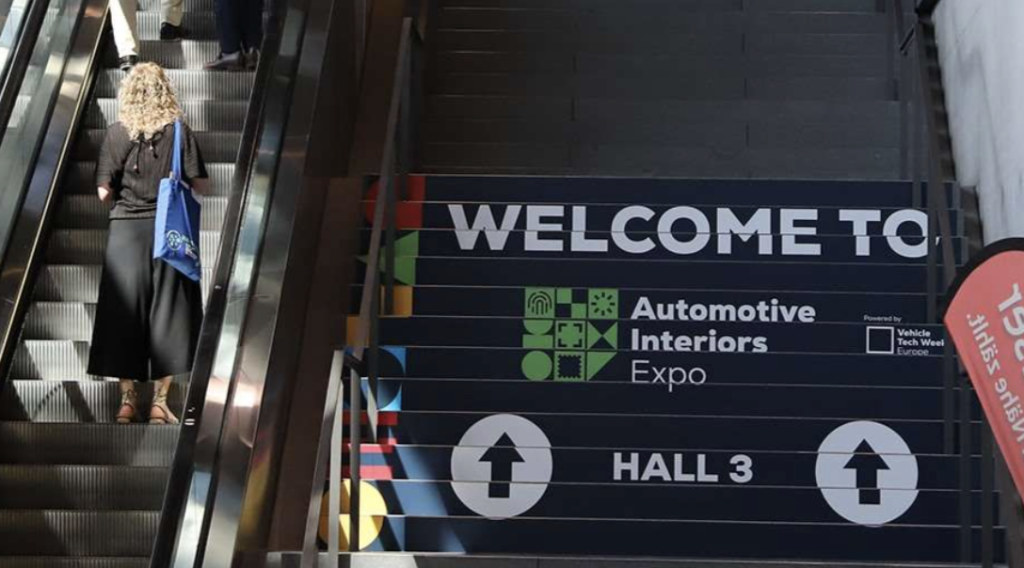
Automotive Interiors Expo Europe 2026, held June 23-25 at Messe Stuttgart, Germany, cemented its reputation as the leading global event bringing together solution providers, industry professionals and expert speakers over three days dedicated to the future of the in-cabin experience. As part of Vehicle Tech Week Europe, the event united three trusted shows: Automotive Interiors Expo, Automotive Testing Expo and Autonomous Vehicle Tech Expo.
Exhibition highlights
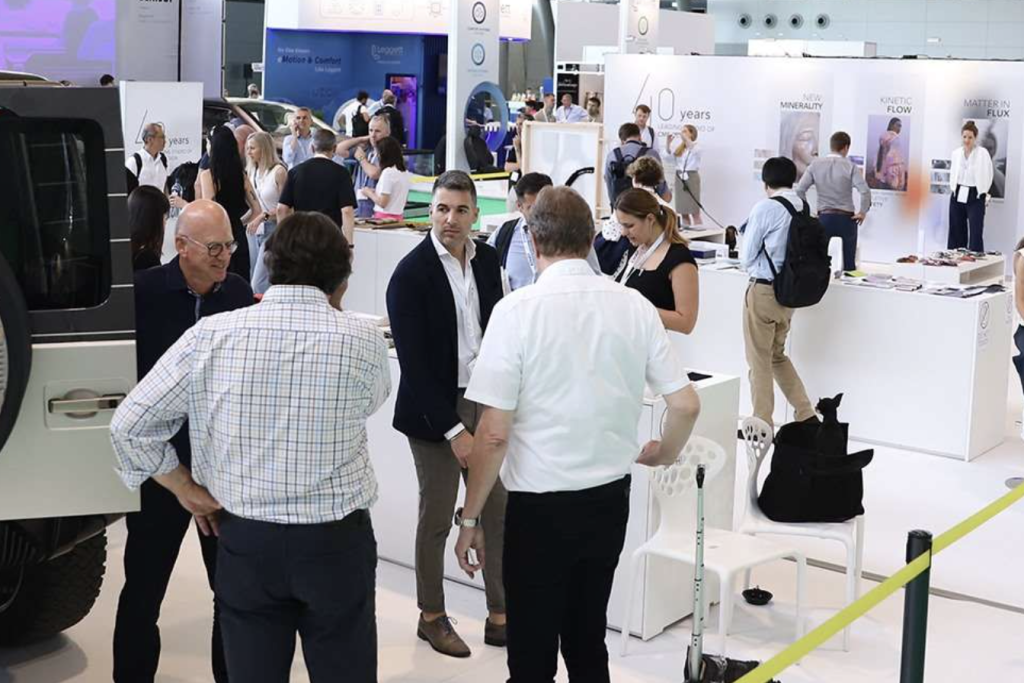
Exhibitors at Automotive Interiors Expo Europe represented the full spectrum of car interior innovation, with products found in vehicles from nearly every major manufacturer, including Ferrari, Maserati, McLaren, Porsche, GM, Volkswagen, Jaguar, BMW, Kia and Toyota.
With companies showcasing next-generation materials and finishes, intelligent surfaces, ambient lighting, digital displays and user-interface innovation – and sustainability, connectivity and personalization running through much of what was on show – OEM attendees commented on the show’s connections and variety:
“It’s really important to be able to see suppliers, and I’m really impressed that here [at vehicle tech week] we have a global footprint and I’ve been able to see some suppliers that I haven’t even been able to see over in China. Being here amongst CMF designers and having a good discussion is something we usually can’t do,” said Steve Stanforth, CMF design chief, Geely Technology Europe, Coventry Creative Centre, UK.
VIP Executive Club
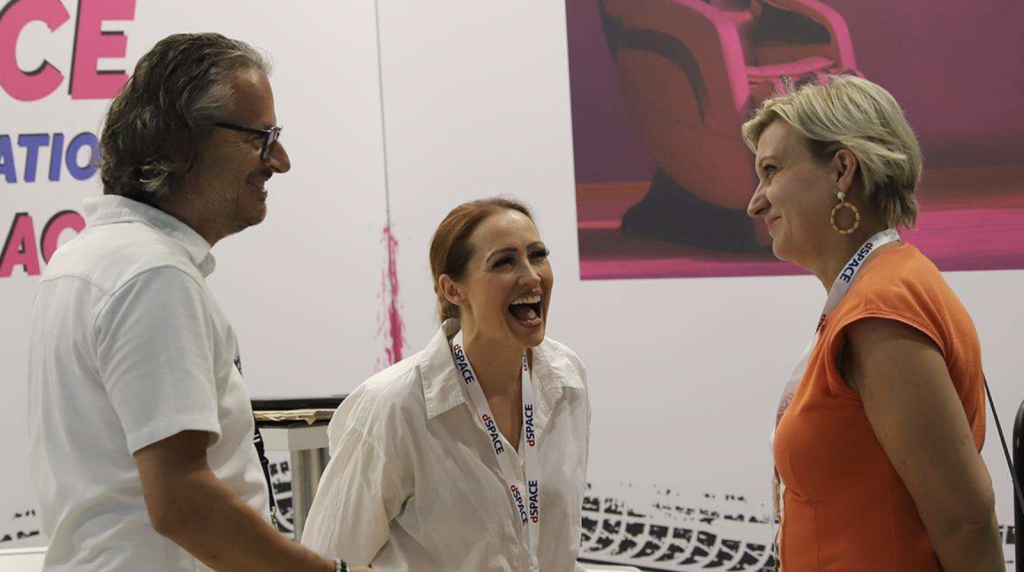
The event also featured the VIP Executive Club, a dedicated space for senior leaders that offeredcurated PeerTalks throughout the show.
“We have had some great sessions and heard some great stories [during the PeerTalks],” said Arun Udamakuyar, systems architect, Jaguar Land Rover.
“In the peer sessions we have been discussing software-defined vehicles (SDVs), the testing and validation, what is working and what the problems are. We have also been looking at possible solutions to the challenges surrounding SDVs. It’s pretty cool to be able to discuss this,” added Afrighi Lirohc, function developer for HV battery, Porsche Engineering.
InteriVision Forum highlights
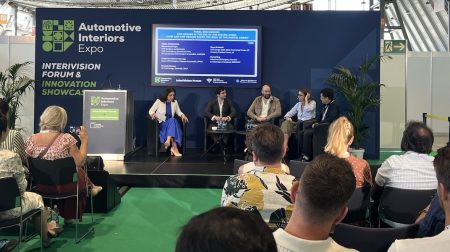
Running alongside the exhibition, the InteriVision Forum brought speakers together for a packed program of presentations and panel discussions exploring the technologies and ideas shaping tomorrow’s cabin.
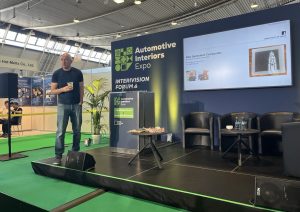
Artur Mausbach, a senior research fellow at the Royal College of Art, presented PaceDriven: A design and business model for the circular economy at the InteriVision Forum. He discussed a design approach developed with Kia that rethinks vehicle circularity by breaking cars into five layers (structure, skin, surface, scenery and stuff) to enable modular, upgradeable interiors adaptable across multiple vehicle types. Rooted in the RCA Hyundai Kia Innovation Laboratory’s Creative Sustainability project, the approach aims to extend product lifecycles, reduce environmental impact and ensure materials are genuinely recyclable rather than compacted into landfill waste – though the key challenge remains translating such concepts into cost-viable, real-world practice.
“The challenge is to make components easily separable, so they can be genuinely recycled rather than becoming the compacted waste that ends up in landfills today. That is the difference we are trying to make,” Mausbach explained.
“Next time you look at a tree, you are looking at a material [cellulose] that is as strong as concrete,” said Michael Ries, professor of soft matter physics at the University of Leeds, who presented All-cellulose composites: Next-generation circular materials, making the case for a resin, glue and epoxy-free material sourced from recycled textiles and agricultural waste that is strong, thermally resistant, biodegradable and manufactured through a low-energy process. Produced at thicknesses up to 2.5cm – sufficient for numerous structural applications, such as steering wheels, the material can be made translucent, shaped into complex forms, and laminated using dissolved cellulose as its own adhesive. Real-world licensing is now the next step. Ries said he was at the expo actively seeking an industry partner to bring the material from concept into commercial application.
The CMF design in the era of the digital cabin panel 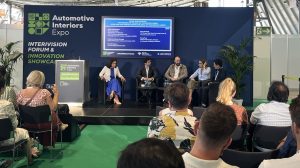 discussion tackled one of the industry’s most pressing tensions: whether the rise of digital screens is eroding the soul of car interiors. Moderated by CMF designer and strategist Burcin Kesercioglu, the session brought together designers from from Changan Automobile, Diconium, Stellantis and Geely, who collectively argued that digital and tactile elements need not compete but must be experienced as a cohesive whole. “The role of CMF designers has evolved from selecting materials to designing experiences,” said Rossella Guasco, VP CMF Design, Stellantis, while Steve Stanforth of Geely Technology Europe reminded the room that the idea of a sanctuary means something different to every user, making balance – not dogma – the real design challenge.
Exclusive interviews
The AIW team used the expo to catch up with a number of key players shaping the future of vehicle interiors. From industry-leading suppliers to designers behind some of the most recognizable OEM visions, the mix of attendees created the ideal environment for meaningful discussions and decisions that move automotive interior design forward.
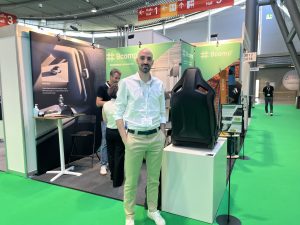
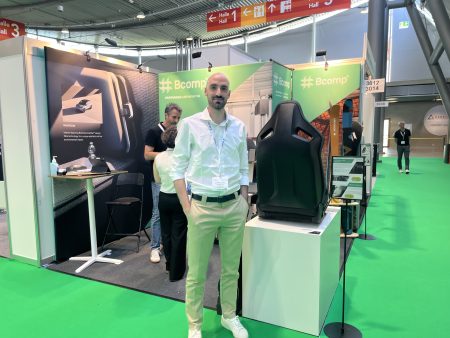
The team caught up with Carmine Landi, automotive customer project engineer at Bcomp, to discuss the company’s natural fiber composite materials and its race-to-road philosophy. Landi highlighted that the EV transition has sharpened thefocus on full-lifecycle material impact, while pushing back on the misconception that natural fibers like flax are soft or inconsistent. With the company’s technology already quietly featured in the BMW M Concept Neue Klasse, Landi’s message to the industry was clear: “Performance, function and aesthetics no longer have to be a trade-off, and we hope more OEMs take this into consideration, especially in an increasingly crowded EV market.”
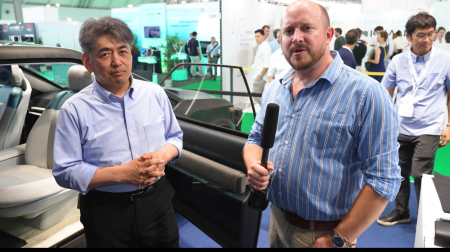
Editor Lawrence Butcher also spoke with a number of OEM design leaders on the show floor in video interviews, including Masashi Yanai, design studio director at Sekisui Europe, who outlined the technologies the company showcased at the expo and explained how its background in chemicals and experience across multiple industries informs its approach to automotive interior solutions. You can watch what Yanai had to say here.
Trailblazer award
 The Automotive Interiors Trailblazer award celebrates leaders redefining the in‑cabin experience by blending creativity, human‑centered design and technical innovation to create intuitive, intelligent and future‑focused mobility interiors.
Michael Duerr, head of interior design at Chery International, won the inaugural Automotive Interiors Trailblazer award, which was presented at a ceremony at the end of Day 2 of Vehicle Tech Week Europe 2026.
Duerr was recognized for bringing the Chery brand to Europe and establishing a cohesive interior design language across Omoda, Jaecoo and Chery – alongside achieving a UK market share of over 6% after launching from scratch in 2024. Read more about the Vehicle Tech Week Awards here.
Don’t miss next year’s show, which will once again take place in Stuttgart, The all-important dates for your diary are June 1-3, 2027