



Close Menu
Automotive Interiors World
  • News
    • A-C
      • 3D Printing
      • ADAS
      • Aftermarket
      • Appointments, Partnerships, Investments & Acquisitions
      • Augmented Reality
      • Automotive Interiors Expo
      • Autonomous
      • Computing
      • Concepts
      • Connectivity
    • D-L
      • Dash
      • Displays
      • EV
      • Graphics & Printing
      • Haptics
      • HMI
      • HVAC
      • Infotainment
      • Lighting
      • Luxury
    • M-S
      • Materials
      • Microprocessors
      • NVH & BSR
      • Personal Assistants
      • Safety
      • Seating
      • Sensors
      • Simulation
      • Sound System
    • S-V
      • Sport
      • Surfaces & Decoration
      • Sustainability
      • Testing
      • Trim
      • Virtual Reality
  • Features
  • Online Magazines
    • May 2020
    • October 2019
    • May 2019
    • October 2018
    • May 2018
    • Subscribe Free!
  • Opinion
  • Videos
  • Supplier Spotlight
LinkedIn
  • Sign-up for Free Weekly E-Newsletter
  • Meet the Editors
  • Contact Us
  • Media Pack
LinkedIn
Subscribe
Automotive Interiors World
  • News
      • 3D Printing
      • ADAS
      • Aftermarket
      • Appointments, Partnerships, Investments & Acquisitions
      • Augmented Reality
      • Automotive Interiors Expo
      • Autonomous
      • Computing
      • Concepts
      • Connectivity
      • Dash
      • Displays
      • EV
      • Graphics & Printing
      • Haptics
      • HMI
      • HVAC
      • Infotainment
      • Lighting
      • Luxury
      • Materials
      • Microprocessors
      • NVH & BSR
      • Personal Assistants
      • Safety
      • Seating
      • Sensors
      • Simulation
      • Sound System
      • Sport
      • Surfaces & Decoration
      • Sustainability
      • Testing
      • Trim
      • Virtual Reality
  • Features
  • Online Magazines
    1. May 2020
    2. October 2019
    3. May 2019
    4. October 2018
    5. May 2018
    6. Subscribe Free!
    Featured
    April 3, 2020

    In this Issue – May 2020

    By Helen NormanApril 3, 2020
    Recent

    In this Issue – May 2020

    April 3, 2020

    In this Issue – October 2019

    September 19, 2019

    In this Issue – May 2019

    April 30, 2019
  • Opinion
  • Videos
  • Supplier Spotlight
  • Events
LinkedIn
Subscribe
Automotive Interiors World
Connectivity

Qualcomm releases details of fourth-gen Automotive Cockpit Platforms

Lawrence ButcherBy Lawrence ButcherJanuary 28, 20213 Mins Read
Share LinkedIn Twitter Facebook Email

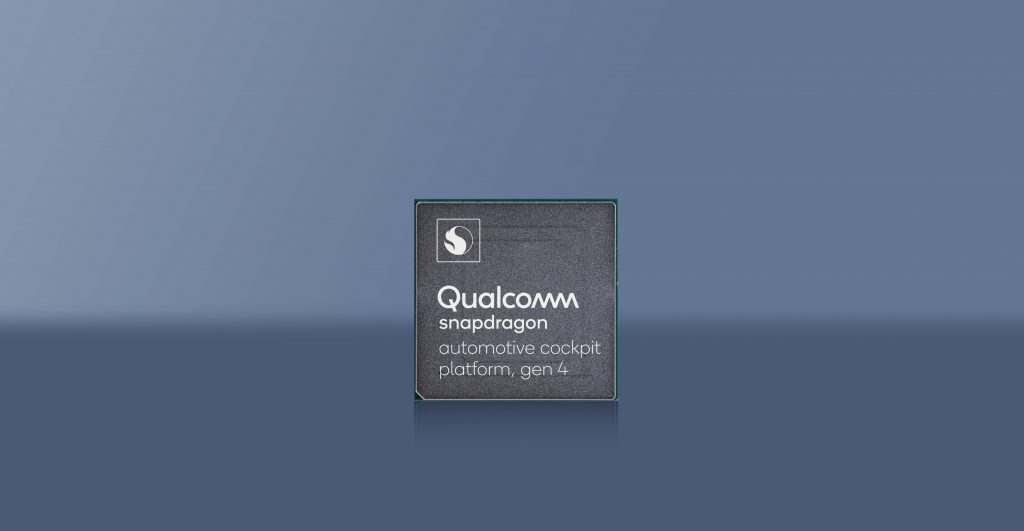
Even though its third-generation systems are only due to enter OEM production vehicles this year, Qualcomm Technologies has released details of its next generation of digital cockpit solutions, the Fourth Generation Qualcomm Snapdragon Automotive Cockpit Platforms.

According to the company, the automotive digital cockpit is evolving toward a zonal electronic/electrical (E/E) compute architecture, driven by complexity, cost and need for a central compute consolidation. To meet these demands, it states its fourth-gen cockpit platforms will serve as a central hub for high-performance compute, computer vision, artificial intelligence (AI) and multi-sensor processing with a flexible software configuration to address the compute, performance and functional safety needs for that zone or domain.

The platforms will be fully scalable and support all three of Snapdragon’s automotive performance tiers; Performance, Premiere and Paramount, for entry level, mid-tier and super computing platforms, respectively.

Through the utilization of 5nm processing technology, Qualcomm claims it can provide auto makers with one of the highest performance system-on-chips (SoC) available, equipped to meet the user experiences of the next generation cockpit with a low-power and thermal profile, as well as car-to-cloud with soft SKU capabilities, facilitating over-the-air (OTA) updates post-deployment and throughout the lifecycle of the vehicle.

According to the company, its platforms are designed to provide software scalability and flexibility, coupled with support for several high-level and real-time operating systems in hypervisor and container software configurations. This supports multiple engine control units (ECUs) and domain consolidation, including cluster and cockpit, augmented reality heads-up-display (AR-HUD), infotainment, rear seat displays, mirror replacement (e-Mirror) and in-cabin monitoring services. It also provides video processing capabilities to integrate drive recording and surveillance functionality.

Furthermore, the same software architecture and framework is used across all tiers, reducing development complexity and commercialization time, while minimizing maintenance costs for auto makers.

“The digital cockpit has become synonymous with the ever-growing need for auto makers to create a unique, differentiated and branded experience for their customer” said Nakul Duggal, senior vice president and GM, automotive, Qualcomm. “With our Fourth Generation Snapdragon Automotive Cockpit Platforms, we strive to deliver the industry’s most advanced digital cabin solutions and aim to reinvent the driver, passenger and rear seat entertainment and contextual awareness experience, while also addressing the auto makers’ shift to zonal compute architectures with the fusion of compute, performance, AI and safety.

“We intend to continue empowering auto makers to scale these powerful automotive cockpits across a diversity of vehicle segments and help auto makers democratize access to advanced infotainment technology that makes each driving or riding experience safer, more comfortable and more personal.”

Qualcomm is targeting the start of production for its new digital cockpit platforms in 2022, while automotive manufacturers will be able to demonstrate and start development of systems based on the product from Q2, 2021.

Share. LinkedIn Twitter Facebook Email
Previous ArticleDeveloping a GUI for the world’s most efficient EV
Next Article Versatile ball tester developed for automotive interior applications

Read Similar Stories

The The NI PXIe-1480 carrier module pictured in profile against a white background.
Testing

Emerson launches NI-powered modular testing architecture for display and camera systems

July 21, 20262 Mins Read
Interior of the new Volkswagen ID Cross compact electric SUV.
ADAS

Volkswagen launches ID Cross compact electric SUV built on MEB+ platform

July 16, 20263 Mins Read
Small language models power offline vehicle intelligence in Microsoft-FEV collaboration.
HMI

Small language models power offline vehicle intelligence in Microsoft-FEV collaboration

July 15, 20263 Mins Read
Latest News
The The NI PXIe-1480 carrier module pictured in profile against a white background.

Emerson launches NI-powered modular testing architecture for display and camera systems

July 21, 2026
Renault adopts recycled end-of-life vehicle plastic in instrument panel.

Renault adopts recycled plastics in instrument panel

July 16, 2026
Interior of the new Volkswagen ID Cross compact electric SUV.

Volkswagen launches ID Cross compact electric SUV built on MEB+ platform

July 16, 2026

Receive breaking stories and features in your inbox each week, for free


Enter your email address:


Supplier Spotlights
  • Formerra
Getting in Touch
  • Contact Us / Advertise
  • Meet the Editors
  • Media Pack
  • Free Weekly E-Newsletter
Our Social Channels
  • LinkedIn
UKi Media & Events
Related UKi Topics
  • Automotive Testing
  • Automotive Powertrain
  • Autonomous Vehicle
  • Professional Motorsport
  • Tire Technology
  • Media Pack
© 2026 UKi Media & Events a division of UKIP Media & Events Ltd
  • Terms and Conditions
  • Privacy Policy
  • Cookie Policy
  • Notice and Takedown Policy

Type above and press Enter to search. Press Esc to cancel.