

Why the shift to relaxed seating in autonomous vehicles could put passengers at greater risk and why we still lack the data to fix it
The seatbelt and airbag transformed vehicle safety in the 20th century. Yet for more than 50 years, occupant safety has been built around one core assumption: a person sits upright, faces forward, hands on the wheel, eyes on the road. Seatbelts, headrests and crumple zones are all engineered around that single driving position.
Autonomous vehicles invalidate that assumption, and engineers must now rethink occupant protection from first principles.
Why the upright seating position paradigm is breaking
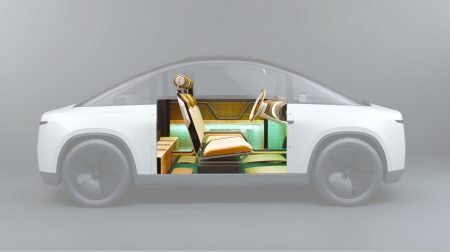
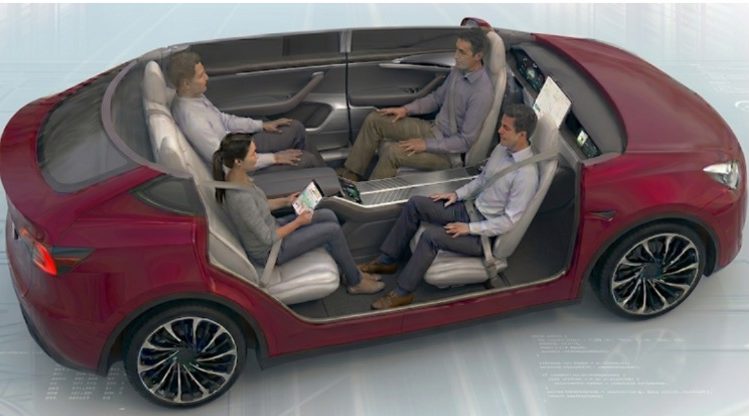
Once autonomous vehicles go mainstream, occupants won’t have to stare at the road on a two-hour commute. They could recline and nap, swivel to face a friend or get some work done during the trip. That changes the entire logic of cabin design. Auto makers are already sketching concept interiors with seats that recline, rotate and support lounge-style postures, on the theory that if no one has to drive, no one has to sit like a driver. The industry calls this zero-gravity seating, and a few production vehicles already offer it. The problem is that virtually every occupant restraint in the global fleet was designed, tuned and certified for someone sitting upright.
These seating positions rarely figure in restraint design. A seatbelt built for an upright torso doesn’t do its job on a reclined body: as recline angle increases, so does the risk of submarining, which can injure the abdomen and spine (see below).
An airbag calibrated to catch the head and chest at a fixed distance is far less effective, and in some cases actively dangerous, if that head is turned sideways, tilted back or is out of position. A rear-facing seat sounds intuitively safer, but at higher crash speeds the chest and pelvis of a reclined occupant remain vulnerable.
What is submarining?
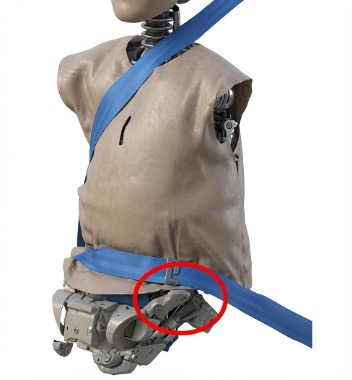
Submarining is the kinematic failure mode in which an occupant’s pelvis slips under the lap belt during a frontal crash, transferring restraint loads from the bony pelvis to the soft abdomen. It causes severe abdominal and pelvic injuries, including organ laceration, mesenteric trauma and pelvic ring fractures, and it is far more likely when an occupant is reclined, because rearward pelvic rotation degrades the geometry that normally keeps the belt seated. Countermeasures include anti-submarining ramps in the seat cushion, lap-belt pre-tensioning and lumbar airbags that resist forward translation of the pelvis.
Regulations need to be updated
Today’s crash-safety regulations were written for a very different vehicle: one with a human driver seated upright and facing forward. Seatbelt, airbag and crash-structure requirements still reflect that assumption, because when the rules were drafted, there was little reason to imagine occupants riding in any other position.
This creates a widening gap between what vehicle technology can enable and what today’s regulations actually address. A manufacturer may be able to build and sell a vehicle that drives itself while passengers rest in unconventional postures, but existing rules do not yet guarantee equivalent protection in those positions. Regulators are beginning to develop new crash tests, injury limits and validation methods, but until those requirements are in place, the gap remains.
The gap is beginning to narrow. In late 2025, Euro NCAP published procedures3 that allow computer-simulated crash tests to count as official evidence for the first time, an important step toward evaluating postures that conventional crash-test dummies cannot reproduce. US regulators outlined a similar path in 20244, calling for next-generation dummies and human-body computer models to assess restraint performance in scenarios current rules do not cover. Even so, this work remains in progress, and broad adoption is likely years away; regulators view 2030 as the earliest realistic milestone.
A 2025 study5 from Chalmers University of Technology, conducted with Volvo and Autoliv, shows how specific these regulatory updates may need to be. The study found that the legally required angle of the lap-belt buckle may need to shift toward vertical simply to keep the belt properly seated on a reclined occupant. It is a small detail of design, but it illustrates the larger problem clearly: a rule written for an upright body can quietly fail once that body leans back.
When seating posture changes, crash risk changes too
As noted earlier, modern safety hardware, including airbag timing and seatbelt pretensioners, was tuned using crash data from occupants sitting upright and facing forward. Comparable data is limited for occupants reclined at 45° or more, seated sideways or riding rear-facing.
Posture changes how the body moves and loads the restraint system in a crash. An occupant who reclines too far faces a higher risk of submarining, as described above. A sideways-facing occupant may be struck by an airbag at an angle it was never designed to manage, or it may miss its protection entirely. A reclined, rear-facing occupant introduces another failure mode in rear-end crashes: the head can move past the headrest and the neck can hyperextend, a motion conventional head restraints were never designed to prevent.
The available data supports this concern. US crash records2 from the National Highway Traffic Safety Administration from 1995 to 2005 show that fully reclined occupants died in frontal crashes at a rate 77% higher than upright occupants. Simulation studies point in the same direction: as the recline angle increases from 25° to 60°, the lap belt loses contact with the pelvis earlier in the crash sequence. Body size, age and shape add further complexity, since restraint systems have historically struggled to protect that variation equally well.
A 2020 study by Volvo and Chalmers University of Technology measured these effects directly by running a THUMS human-body model through a simulated 56km/h frontal collision at three seatback angles.
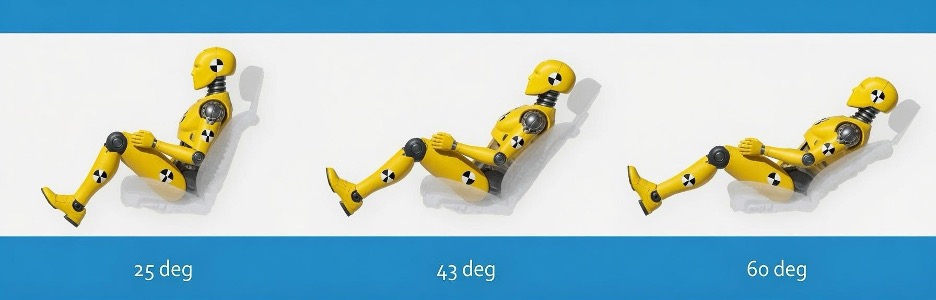
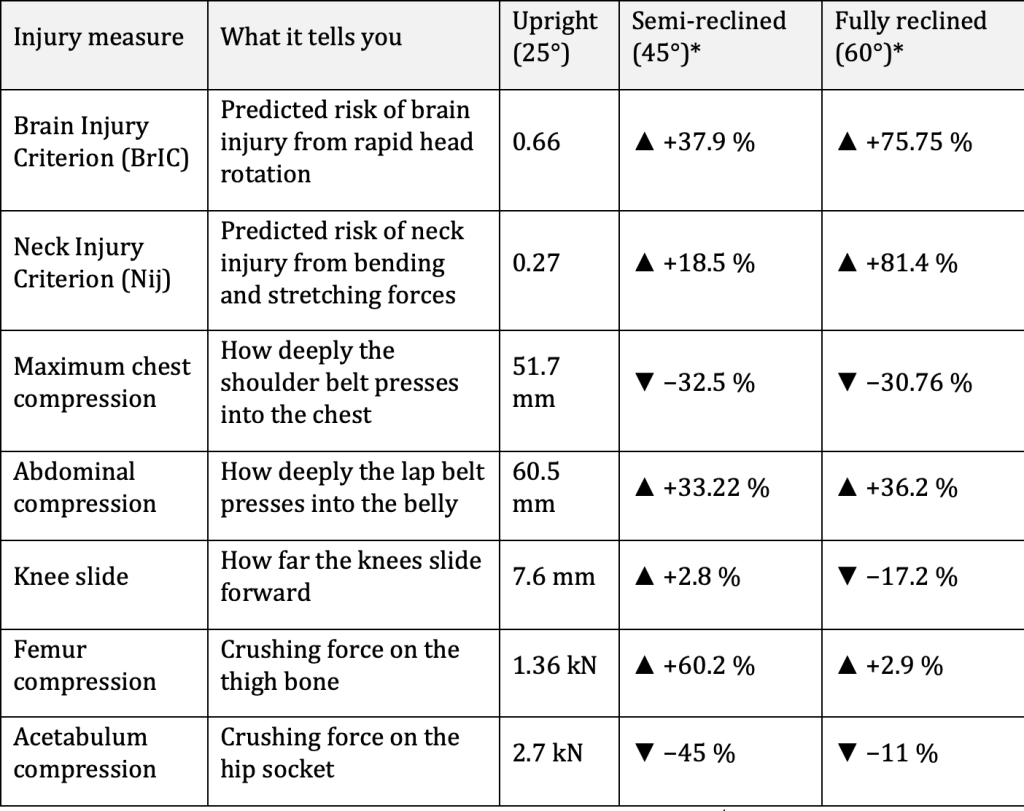
Two findings stand out. First, the brain injury criterion nearly doubles between the upright and fully reclined positions; at 60°, it exceeds the threshold used in official US crash ratings. Second, abdominal compression rises sharply beyond 25°, consistent with the submarining mechanism described earlier: once the lap belt loses the pelvis, the restraint load shifts into the abdomen. Chest compression, by contrast, decreases with recline. That may sound reassuring, but it is not; it suggests the shoulder belt is engaging the chest later and less effectively, not that the crash is less severe.
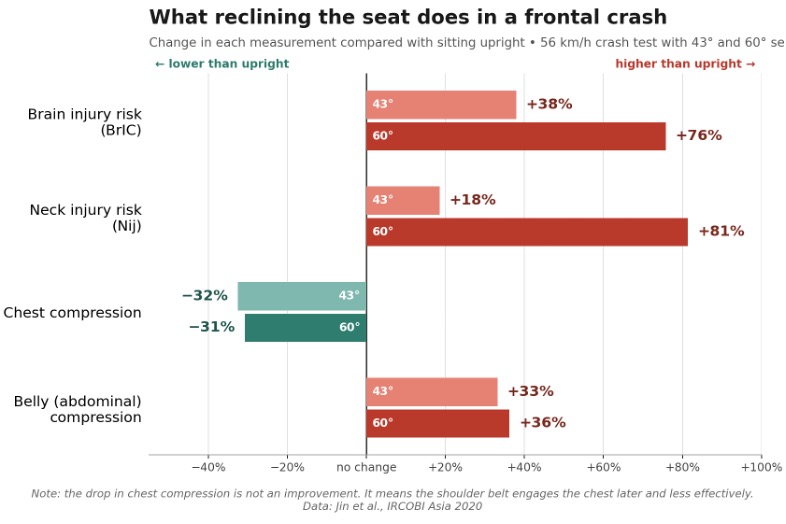
Source: L Jin, J., Li, X., Dong, C., He, X., & Yao, J. (2020). Investigation of Occupant Kinematics and Injury Risks in Semi-Autonomous Vehicle Collisions. IRCOBI Asia 2020, pp. 118–121. (Source of the injury values table and submarining-timing data.)
Taken together, these findings show that restraint systems have not yet caught up with the cabins they may soon need to protect. Future interiors may allow occupants to recline, rotate or ride rear-facing, but each posture changes the way the body moves in a crash and the way the restraint system must respond.
Before lounge seating, rotating chairs or rear-facing rows can responsibly reach production at scale, engineers and regulators will need stronger evidence, better test tools and updated safety standards.
Sources
- Jin, J., Li, X., Dong, C., He, X., & Yao, J. (2020). Investigation of Occupant Kinematics and Injury Risks in Semi-Autonomous Vehicle Collisions. IRCOBI Asia 2020, pp. 118–121. (Source of the injury values table and submarining-timing data.)
- Luttenberger, P., Feist, F., Kofler, D., Sinz, W., D’Addetta, G.A., Freienstein, H., & Wolkenstein, M. (2020). Assessment of Future Occupant Restraint Principles in Autonomous Vehicles. IRCOBI Conference 2020. (Source of the NASS-CDS reclined-occupant fatality data.)
- Euro NCAP, Hybrid III Model Qualification Procedure, version 1.2, December 2025.
- National Highway Traffic Safety Administration (NHTSA), biomechanics and Human Body Model research roadmap, March 2024.
- Brynskog, E., Östh, J., Larsson, K.-J., & Iraeus, J. (2025). Effect of Occupant and Restraint Variability in Reclined Positions on Submarining Probability in Frontal Car Crash Scenarios. Frontiers in Bioengineering and Biotechnology. (Source of the buckle-angle regulatory finding.)
For more information on unconventional seating configurations testing see the Laid-back attitude feature in the 2025 issue of Crash Test Technology International.
Related news, Nexteer’s compact high-mount actuator architecture enables greater cockpit design flexibility