
 Ahead of his presentation at Automotive Design & In-Cabin Conference, Manoj Kumar, software architect at Ford Motor Company, talks to Automotive Interiors World about bridging the SDV validation gap and using AI for verification and validation in multi-OS cockpits
What’s one thing happening in the industry right now that people can’t afford to ignore?
One important development that the industry cannot afford to ignore is the growing regulatory and consumer-safety focus on how drivers interact with the cockpit. Euro NCAP’s 2026 protocol places greater emphasis on providing easily accessible controls for important functions such as indicators, hazard lights, the horn, windshield wipers and headlights. China is moving even further, with proposed requirements covering functions such as ADAS activation, defrosting and power-window operation.
However, I believe the bigger signal is not simply the return of physical controls. The bigger signal is that the HMI is becoming a safety-relevant engineering artifact that must be objectively validated. The layout, information hierarchy, control placement, visibility and interaction behavior can no longer be treated only as matters of design preference. They must be evaluated against measurable safety and usability requirements. The challenge is that many organizations still do not have the tools needed to measure these characteristics continuously and at scale.
What’s the biggest misconception in your field?
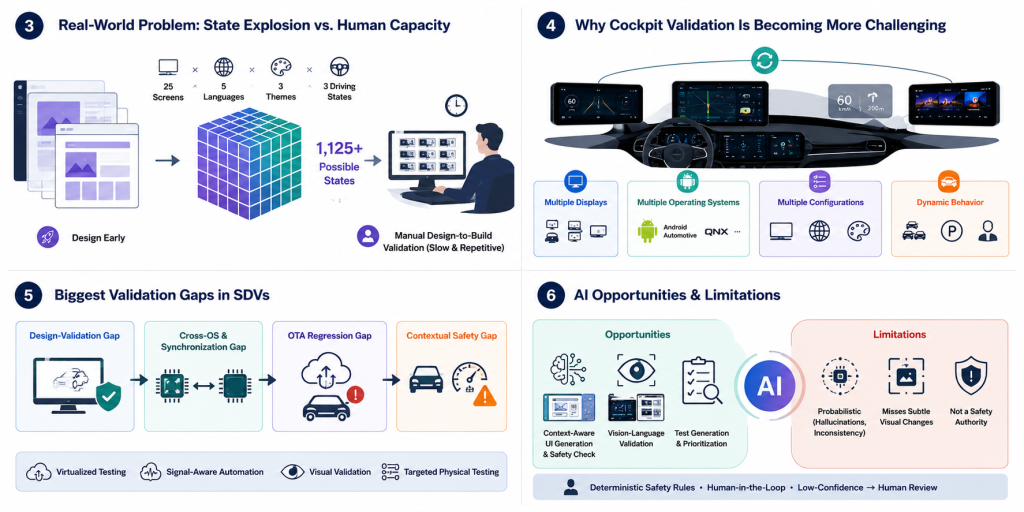
The biggest misconception is that automotive HMI testing is essentially mobile-app testing on larger screens. An automotive cockpit operates under very different conditions. A mobile application typically runs on one device and one operating system. An automotive HMI may operate across a center display, instrument cluster, head-up display, passenger display and rear-seat displays. These surfaces can have different sizes, configurations and responsibilities, and they may run on different operating systems. They must also respond correctly to vehicle signals, driving states, regional restrictions and multiple forms of input, including touch, voice, steering-wheel controls and physical switches. Traditional manual quality assurance and mobile-style automation alone cannot scale to the complexity and release frequency of modern software-defined vehicles. Automotive HMI validation must examine not only whether a function works, but also whether the correct information appears on the correct display, in the correct state, at the correct time.
Many OEMs are accelerating their software-defined vehicle strategies. Where do you see the biggest validation gaps emerging today?
I see four major validation gaps. The first is the design-validation gap. Designers may create an approved design, but teams still need to determine whether that design works across all vehicle variants and whether it satisfies applicable automotive safety and usability requirements.
The second is the cross-display and cross-OS verification gap. Individual applications may work correctly, but teams must also verify that data and visual states remain synchronized across the center display, cluster, head-up display and other surfaces.
The third is the OTA regression gap. A relatively small software update can affect components and screen states far beyond the area being modified. Without effective impact analysis and automated regression testing, it is difficult to know how much of the cockpit must be revalidated.
The fourth is the contextual-safety gap. A platform may expose the current vehicle state or applicable UX restrictions, but that does not automatically prove that the rendered interface follows those restrictions. We must verify the actual behavior and the pixels presented to the driver. Closing these gaps requires a combination of virtualized testing, signal-aware automation, visual validation and targeted physical testing. No single tool can solve the entire problem.
AI is increasingly being applied across vehicle development and validation. What opportunities does it create, and what limitations should engineers be aware of?
AI creates several opportunities across automotive HMI development and validation. First, a generative system can use a verified automotive UI database together with contextual inputs to propose an interface appropriate for a particular situation. For example, it could simplify the screen during a demanding driving situation and prioritize navigation, warnings or frequently used controls. The proposed layout can then be checked by a separate deterministic safety gate. The AI generates the design, but the deterministic gate decides whether the design satisfies the mandatory rules.
Second, vision-language models can inspect an interface in a way that is closer to human visual review. They can compare a rendered screen with an approved design and reason about text, alignment, element states, visual hierarchy and behavior under different contextual inputs.
Third, AI can help generate and prioritize test cases using UX specifications, system requirements, vehicle context and recent software changes. It can also help provide dynamic inputs to the system under test and identify combinations that may otherwise be overlooked.
At the same time, engineers must recognize that AI models are probabilistic. They can report defects that do not exist, miss subtle icon or color-state changes, and sometimes produce different conclusions for the same inputs. For that reason, safety critical requirements such as mandatory control presence, vehicle-state restrictions, minimum target sizes and alert priorities should be enforced through deterministic and auditable code. Low-confidence AI conclusions should be routed to a human reviewer rather than automatically treated as a pass or failure.
What should engineers working on software-defined cockpits be focusing on over the next few years?
Building cockpit architecture that’s observable, testable and fails safely. Make your design specification machine readable. If your spec carries roles for UI elements, target sizes, priorities and the contextual conditions each applies to, it stops being a picture and becomes ground truth a machine can check against. That one change unlocks most of the automation downstream.
Turn the distraction rules into executable constraints. ISO 15008 and the NHTSA guidelines currently live in documents that designers cite. They should be code running in your validation pipeline, returning pass or fail. Rules you can execute, not rules you can quote.
Move validation into software-in-the-loop and virtual environments, so you can exercise large configuration matrices before hardware exists. HIL still matters but it should be spending its time on timing, integration and physical behavior, not repeating basic UI checks that could have run in simulation.
And use AI aggressively wherever the output is checkable, but treat everything it produces as unverified until it’s been through the same static analysis, review and traceability you’d apply to human work. The goal isn’t maximum autonomy. It’s maximum useful automation with a clearly defined failure mode, and a human in the loop where the model is unsure.
You will be speaking on this subject at the Automotive Design & In-Cabin Conference at Vehicle Tech Week North America in October. What will attendees learn from your presentation that they won’t get anywhere else?
This session connects two parts of the problem that are usually discussed separately. The first is preventing an unsafe or distracting interface from being designed in the first place. This is addressed through context-aware generation combined with a deterministic safety gate. The second is proving that an approved design was implemented correctly in the actual vehicle software. This is addressed through vision-language-based design-to-build validation.
These are two different failure modes. A design itself can be unsafe, or a safe design can be implemented incorrectly. Solving only one of these problems still leaves the cockpit exposed. Attendees will see how the two approaches can form a closed validation loop – from context and design intent, through implementation, to the final pixels rendered inside the vehicle. They will also leave with a practical understanding of where AI adds value, where deterministic validation is required and where human judgment must remain part of the process.
What are you hoping to learn, explore or discover at Automotive Design & In-Cabin Expo North America?
I want to understand how other organizations are validating the complete cabin experience rather than individual components. Specifically, how teams are handling cross-display synchronization, driver monitoring, adaptive interfaces, accessibility, display performance, and the integration of physical and digital controls. And I’m looking for practical examples of AI that have actually crossed from demonstration into production engineering workflows not pilots – production. Most of all, I want to find out where OEMs, suppliers, designers and test-tool providers draw the boundary between virtual validation and physical cabin testing.
Don’t miss Kumar’s presentation, titled ‘Bridging the SDV validation gap: An AI-driven framework for verification and validation in the multiple display and multi OS cockpits,’ at Automotive Design & In-Cabin Conference, part of Vehicle Tech Week North America 2026. Read more about this presentation in the September 2026 issue of Automotive Testing Technology International, and find full details on Automotive Design & In-Cabin Expo North America 2026 here