

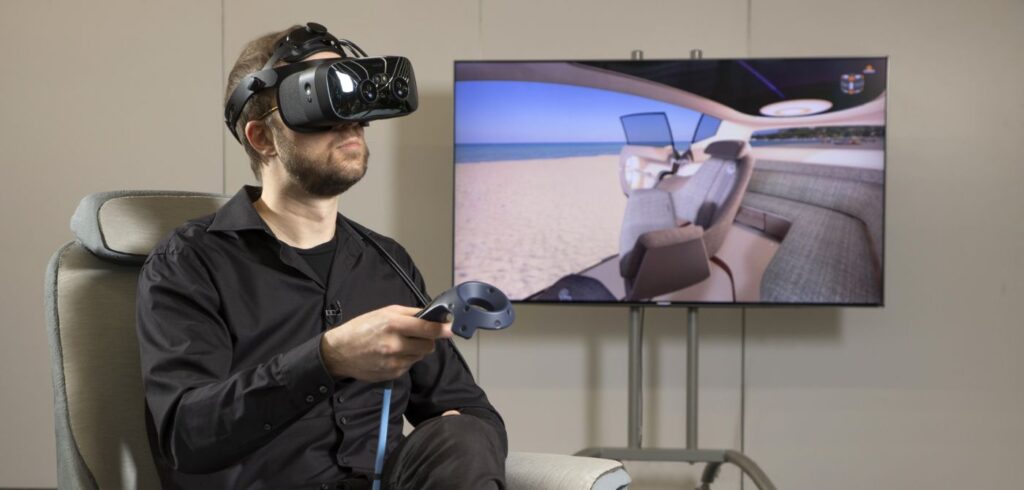
Hyundai has recently highlighted the advances made in the use of VR technology by its design and development teams on new vehicle projects. Its designers work with industry-standard software that has been reprogrammed so that they can work in collaboration across multi-user and multi-location environments.
Using this software, they are able to create models and immersive environments in VR. This, the company says, has opened up a host of new opportunities. For example, what is known as a gravity sketching tool enables designers to create more human-centric vehicle designs by working in 3D from the start. By working in 3D, Hyundai’s designers can experiment with different proportions and build variations based on their ideas. Meanwhile, a 360° view of the vehicle enables them to sketch from any angle – in contrast to the traditional 2D process.
3D gravity sketching also enhances the collaboration between Hyundai’s exterior and interior designers. Through this technology, the two teams are able to work together simultaneously. While the exterior design team refine the digital model, the company’s interior designers can work in parallel by virtually stepping inside the car to develop features or make quick adjustments.
Hyundai’s journey in multi-user wireless VR spaces started in 2017. Then, in December 2019, Hyundai Motor Company and Kia Motors Corporation announced an ambitious new virtual reality (VR) design evaluation system. Two years on, this has now been fully implemented. With facilities in Namyang (Korea), Rüsselsheim (Germany), and Irvine (California), designers and engineers are able to review a multitude of design concepts earlier in the developmental process, and in ways that were previously physically impossible. VR headsets enables staff from various departments to enter a virtual conference in real time and simultaneously undertake vehicle design quality assessments and development verification processes, no matter where they are in the world.
Hyundai has also established remote VR design assessment capabilities to enable real-time virtual collaboration between its design centers in Europe, Korea, China, India, Japan and the USA. These changes were already underway before Covid-19 emerged and sent the world into lockdown in early 2020. According to Simon Loasby, Hyundai head of styling, the pandemic served as a catalyst accelerating the transition to digitalization and agile working.
“When our studios across the world were sending all the designers home, we were fortunate that we were already operating a very well-oiled machine in terms of remote virtual connection, where we could all connect across three different continents and five different locations into a virtual working space and walk around the cars,” said Loasby.
The adoption of collaborative VR systems also means that staff at Hyundai’s European Design Center, located at the Hyundai Motor Europe Technical Center (HMETC) in Rüsselsheim, Germany, can work in much closer collaboration with the company’s global R&D Center in Namyang. The aforementioned advancements in VR technology enable designers based at HMETC to communicate with their counterparts in Korea at a much earlier stage of development.
HMETC’s 20 x 23m Vision Lab, which was previous used for analog presentations, recently received a substantial upgrade. This was completed in November 2021. It has been completely renovated and is now outfitted with what Hyundai states is some of the most advanced design technology in the automotive industry, including 48 cameras with active tracking.
“Our new HMETC Vision Lab is a marvel in terms of infrastructure and technology. The combination of 3D software and VR goggles enables us to dive into a virtual environment, seeing the car in full size and 3D as if we were standing right next to a physical model,” remarked Thomas Bürkle, Hyundai’s chief designer in Europe.
“In this virtual 3D environment, we can also stand just 1m away from our global head of design, who is based 10,000km away from the European studio. This means we’re able to freely exchange concepts within our global design organization and make much quicker developmental decisions and technical assessments from the very outset of a project.”
One of the major enhancements to HMETC’s Vision Lab is its LED wall, which features an integrated 8K video system. Up to eight streams can be displayed on the screen, which enables people who are not participating in a virtual conference with VR headsets to join.
“In the Vision Lab, our designers are able to make adjustments to the digital model with much greater accuracy using not just VR, but also AR and mixed reality. They’re able to home in on a bumper detail using digital laser pointers, for example, and can define lines and shapes more accurately and efficiently than in the past,” added Bürkle.
“The almost immediate visualization of design data can also be quickly shared with engineers at a very early stage of the project, so the designers get faster feedback for modifications. These levels of precision allow Hyundai to respond quickly and react with agility to the needs of our customers, as well as the paradigm shifts in the automotive industry.”